
The WhatsApp Business Platform: Capabilities, Constraints, and the Multi-Channel Opportunities in 2026
Something fundamental has changed in how businesses and customers communicate in a mobile-first world.
Published April 14, 2026.
In
.
Written by Phumlisa Zibaya.
Something fundamental has changed in how businesses and customers communicate in a mobile-first world.
Table of Contents
Share this post
Recently, the messaging landscape has been reshaped by a convergence of forces that would have seemed speculative just a few years ago. What we are seeing today is the mass adoption of rich business messaging globally by enterprises and non-profits. Apple’s decision to natively support RCS in iOS 18 has accelerated the adoption of rich, carrier-based messaging to align with Google’s expansion of RCS adoption within the Android messaging ecosystem. Meta has expanded WhatsApp’s business messaging capabilities at pace, including an imminent shift in how businesses are identified on the platform, moving from phone numbers to username-based handles, with a technical transition deadline of June 2026. A global pricing overhaul has forced high-volume senders to rethink cost models. And the arrival of AI agents inside messaging threads has begun to redefine what “customer interaction” actually means.
Together, these shifts have repositioned business messaging from a peripheral communication channel to the primary customer interface layer of commercial relationships.
WhatsApp is one of the clearest expressions of this shift. With over 3 billion active users worldwide, WhatsApp has evolved from a consumer messaging tool into a business communication platform, reshaping customer engagement, service delivery, and the very model of the global telecommunications industry. Its business platform offers verified profiles, rich media, interactive flows, AI-assisted automation, and a direct line to customers who have opted in to hear from you. For many organisations, it has become one of the most powerful customer engagement channels introduced. But WhatsApp as a platform is not without business and market constraints. Its scale and capability are matched by structural dependencies: pricing and policy are controlled unilaterally by Meta, template approval introduces some operational friction, account quality directly impacts reach, and coverage gaps remain in markets where WhatsApp is not dominant.
This is where the idea of a single-channel approach for business messaging begins to break down. In practice, modern messaging strategies operate across multiple channels. RCS for Business provides rich, native-app messaging experiences. SMS remains the universal fallback, guaranteeing delivery where no other channel can. WhatsApp Business Platform enables deep, conversational engagement. These channels are not interchangeable. Instead, they are complementary, and orchestrating between them is what separates fragile, single-channel programmes from resilient, enterprise-grade messaging infrastructure.
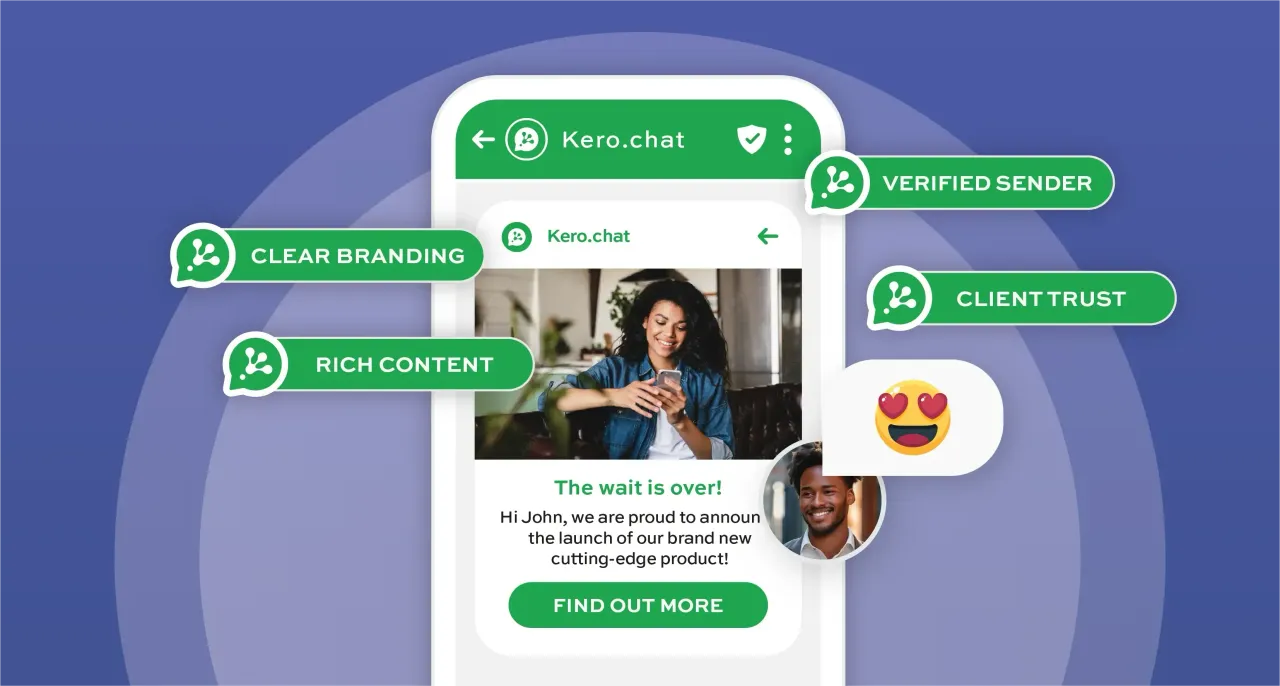
This is precisely the layer at which messaging platforms like Kero operate, enabling businesses to move beyond channel-specific deployments toward orchestrated messaging strategies that adapt in real time. As a Meta-registered Tech Partner and rich business messaging platform, Kero supports the WhatsApp Business Platform, RCS for Business, and SMS, routing intelligently across them based on customer device, channel availability, and message type.
This whitepaper examines the landscape Kero operates in: what the WhatsApp Business Platform offers, where it introduces risk, how pricing works in 2026, and why the businesses that will succeed in the messaging era are those building channel-agnostic infrastructure rather than relying on a single platform.
Introduction: The Evolution of Business Messaging
For most of the 20th century, business communication followed predictable, institution-driven channels. The arrival of mobile telephony in the 1990s introduced SMS – short, asynchronous text messages that became the default channel for transactional alerts, two-factor authentication codes, and promotional messages, and voice calls remained the foundation of customer service. Telecommunications companies (telcos) were the indispensable intermediaries in all of this: the pipes, the infrastructure, the billing.
That model began to fracture with the rise of smartphones and internet-native messaging platforms. WhatsApp, launched in 2009 and later acquired by Facebook (now Meta) in 2014, quickly became the dominant messaging platform outside of East Asia. Its appeal was simple: free messages and calls over an internet connection, delivered through a frictionless user experience. By the early 2010s, it was clear that consumer behaviour was shifting irreversibly. SMS volumes began to plateau and decline, and voice revenues softened. The telco model, built on charging per message and per minute, found itself increasingly obsolete.The global shift toward internet-based messaging has been staggering in scale.
WhatsApp now handles billions of messages daily and, in many regions across Africa, Latin America, Southeast Asia, and parts of Europe, has become the default medium for communication between friends and families, customers and businesses, communities, and increasingly, institutions themselves. For businesses, the question quickly became not whether to engage customers on WhatsApp, but how. Early adoption was informal, with businesses relying on personal numbers and manual interactions. It was effective in the short term, but operationally limited. Meta’s response was to formalise the opportunity: first with the WhatsApp Business App, which has become a solution for small business, and later, through the WhatsApp Business Platform (API), which opened the platform to enterprise-grade integrations.
The Messaging Landscape in 2026
To understand why WhatsApp Business Platform has become such a critical business channel, you first need to understand what has happened to the channels it is replacing.
Traditional communication channels such as email and call centres remain widely used, but their effectiveness has steadily eroded in a digital-first economy.Email, once the backbone of business
communication, has become increasingly misaligned with how customers behave today. Global business-to-customer (B2C) open rates range between 20 and 30 percent, and a meaningful share of those emails are opened more than 24 hours after delivery, often long after the moment of relevance has passed.Call centres, meanwhile, have shifted from being a primary support channel to a last resort.
Rising wait times, increasing operational costs, and declining customer satisfaction reflect a deeper issue: customers no longer want to work for support. They expect it to be immediate and accessible on their terms.In parallel, richer messaging has established itself as the central mode of communication
Across both personal and business contexts, users have shifted from broadcast-based communication to two-way, conversational engagement. Messaging platforms enable interactions that are immediate, contextual, and persistent, characteristics traditional channels struggle to replicate.
As a result, what has emerged is increasingly referred to as the chat economy: an environment in which conversations, rather than campaigns, form the basis of customer engagement.
A key force behind this transformation is a recalibration of customer expectations. Modern consumers operate within an instant-gratification economy, where speed is no longer a differentiator but a baseline. 88% of WhatsApp messages are read within the first five minutes of delivery, 33% of consumers prioritise immediate responses above all other factors in a brand interaction, and 82% would choose a chatbot response over waiting for a human agent. A 48-hour response window, once considered acceptable in email communication, is now widely perceived as a service failure.
Messaging platforms meet this expectation by enabling asynchronous continuity. Unlike web chat sessions that expire or phone calls that require both parties to be present, messaging allows conversations to unfold over time without losing context. A customer can initiate a query, return hours later with additional information, and complete the interaction within a single thread. While changes in customer behaviour have driven the rise of messaging, platform-level developments have accelerated its adoption as a core business channel.Meta’s strategic shift in 2025 marked a t
urning point. The deprecation of the On-Premises API in favour of a fully cloud-hosted infrastructure removed a significant barrier to scale. Businesses can now expand from thousands to millions of interactions without proportional increases in technical complexity. At the same time, the introduction of features such as WhatsApp Flows – enabling structured, app-like experiences (forms, booking journeys, data capture) directly within chat – has expanded messaging from a communication tool into an interaction layer. Increasingly, tasks that previously required dedicated mobile applications can now be completed entirely within a messaging thread.
It is precisely this alignment between evolving customer expectations and platform capabilities that defines the current landscape. The result is a fundamental shift in how businesses engage with customers.
Messaging is no longer simply another channel alongside email, SMS, or mobile apps. It is becoming the interface through which these interactions take place, where support is delivered, transactions are completed, and relationships are maintained.
It is within this context that platforms like WhatsApp have moved from optional engagement tools to critical components of modern enterprises’ customer communication strategies.
Understanding the WhatsApp Business Ecosystem
Meta offers two distinct products under the WhatsApp Business umbrella, designed for different scales of operation.
Feature | WhatsApp Business App | WhatsApp Business Platform (API)
Target Audience | Small businesses | Medium and large enterprises
Supports Integration | No | Yes (CRM, platforms, internal systems)
Scalability | Limited | High
Automation | Basic (greetings, quick replies) | Full automation capability
Broadcast Limit | 256 contacts | Unlimited
Quality Rating System | No | Yes - restrictions apply if degraded
Audit Trail | No | Yes
Number of Devices | 5 | Unlimited
Cost | Free | Usage-based pricing via Meta
Catalogue/profile | Basic business profile & catalogue | Configurable via API
The WhatsApp Business App is a free iOS/Android application for small businesses, offering a business profile, quick replies, automated greetings, and basic catalogue functionality, but limited to a single user per account with no meaningful scalability.
The WhatsApp Business Platform (formerly the WhatsApp Business API) is an entirely different proposition built for medium and large enterprises. It enables automation, integration with internal systems, and communication at scale. Without it, WhatsApp remains a purely manual channel. Unless otherwise stated, all references to ‘the platform’ throughout this whitepaper refer to the WhatsApp Business Platform.
The platform operates within an ecosystem fully governed by Meta, who controls the Cloud API infrastructure, pricing, policy, and feature availability; all of which may change unilaterally. Account performance is managed through a quality rating system, and sustained degradation can result in messaging restrictions. Data processing occurs within Meta’s infrastructure, which may require evaluation for organisations with specific governance requirements.
None of this diminishes the platform’s value; in most markets, it remains one of the most effective customer engagement channels available. It does, however, define the nature of the dependency, and for organisations deploying WhatsApp for business at scale, that dependency should be understood explicitly and reflected in architectural decisions that avoid reliance on a single channel as a point of failure.
Strategic Capabilities and Features
The WhatsApp Business Platform functions as an end-to-end interaction layer, capable of supporting the full customer journey, from initial contact through to completed transaction, within a single conversation thread. What makes that possible is not any single feature, but the way its capabilities compound across three dimensions: infrastructure, identity and trust, and interaction depth.
At the infrastructure level, the Cloud API is designed to support high-volume, concurrent messaging, allowing businesses to scale from thousands to millions of conversations without a proportional increase in operational complexity. It operates as a headless service, integrating with existing CRM platforms, helpdesk tools, and enterprise resource planning systems – extending the current operational stack rather than displacing it. A customer query initiated on the platform can be routed, enriched with account history, and resolved within the same systems that manage every other customer touchpoint, maintaining continuity across channels.
Identity and trust sit at a different layer, but they are equally foundational. Businesses that meet Meta’s verification criteria receive a badge against their display name, distinguishing them from unverified accounts. In sectors where impersonation carries material risk – financial services, healthcare, and public services among them – identity is not a secondary consideration, but the foundation on which the interaction itself is built.
Where the platform’s strategic value becomes most apparent, however, is in the depth of interaction it enables. Structured messaging formats – buttons, list selections, and multi-step flows – allow businesses to design guided customer journeys native to the messaging environment. WhatsApp Flows extends this further, enabling complex interactions such as appointment scheduling, product configuration, data capture, and consent management to be handled entirely within the conversation, without redirecting users to external interfaces. In supported markets, native payment capabilities and integrated product catalogues compress the customer journey further still, allowing discovery, consideration, and purchase to occur within a single thread. And with Meta’s agent-assist tooling now a production capability rather than a roadmap feature, high volumes of inbound interactions can be managed with the responsiveness and continuity the channel demands, without a corresponding increase in human resource.
Together, these capabilities define what separates the WhatsApp Business Platform from a mobile messaging channel in the conventional sense. Understanding how they are accessed and charged for, however, is equally important, and that model has changed significantly.
Pricing
From 2022 through 2024, pricing on the WhatsApp Business Platform followed a per-conversation model. A conversation was defined as a 24-hour window between a business and a customer. Once opened, any number of messages exchanged within that period incurred a single charge. This structure encouraged richer, multi-message interactions and made cost modelling relatively straightforward.
As of July 2025, that model has been replaced. Pricing has shifted to a per-message structure across all categories and regions. Businesses are now charged per template message delivered, and the 24-hour billable window has been removed. The result is greater pricing granularity, but also increased variability, as costs are now determined at the level of the individual message rather than the interaction as a whole.
Pricing Categories
The platform organises messaging into four categories, each priced and governed differently.
html
Marketing messages carry the highest rates, reflecting their commercial intent. Utility and authentication messages are lower-cost, supporting high-frequency, transactional use cases. Pricing also varies by geography and volume, with discounts applied at scale.
The Service Window
One significant distinction remains. Conversations initiated by the customer, rather than the business, are not subject to per-message charges within a 24-hour response window. Once a customer makes contact, the business can respond freely during that 24-hour period.
This creates a clear economic asymmetry. Outbound messaging is metered and costed at the message level, while inbound conversations open a temporary window of cost-free engagement. The practical implication is that the platform’s pricing structure naturally favours inbound-led design, not only because inbound interactions tend to reflect higher customer intent, and ensure customer consent to communicate, but because they are materially more cost-efficient to operate within.
Implications for Cost Modelling
The shift from per-conversation to per-message pricing introduces a different set of trade-offs. Under the previous model, additional messages within an open conversation carried no marginal cost. Under the current model, every outbound message is an incremental expense.
This has a direct effect on how messaging programmes should be designed. Message frequency, sequencing, and structure become economic decisions and not just communication choices. High-volume strategies require tighter control. Personalisation and targeting become more directly tied to demonstrable return.
Pricing is no longer just a function of volume alone. It is a function of how messaging is structured.
For businesses operating across multiple messaging channels, this introduces an additional layer of optimisation. Kero’s routing architecture addresses this directly, enabling cost-aware message distribution across WhatsApp, RCS, and SMS so that pricing shifts on any single channel don’t require restructuring the programme.
The Conversational Commerce Opportunity
WhatsApp’s scale is without parallel in the messaging industry. Three billion monthly active users, dominant market share across six continents, and an engagement profile that consistently outperforms most digital channels. That foundation matters, but it is not, on its own, what makes the platform strategically significant for commerce.
What matters is what has been built on top of it.
Over the past several years, WhatsApp has developed into a commerce-capable interaction layer that compresses the distance between conversation and conversion in a way no previous messaging channel in these markets has achieved.
The conventional digital commerce journey is fragmented by design. A promotional message arrives, a link is tapped, a browser opens, a product page loads, and a checkout flow begins. Each transition introduces friction, and each point of friction introduces drop-off. WhatsApp collapses that journey into a single, continuous thread. Through product catalogues, structured message flows, and native payment integration in supported markets, a customer can receive a personalised offer, browse, ask questions, and complete a purchase without leaving the conversation.
This represents not an incremental improvement on the existing model, but a structural change in how the relationship between a business and its customer can be designed.
Conversational commerce at scale is not a new concept. Platforms such as WeChat and Alipay established its viability in East Asian markets years before WhatsApp began developing comparable capabilities. What WhatsApp has done is bring that model – commerce embedded within messaging, rather than adjacent to it – into the markets where it holds dominant share: Latin America, Africa, South Asia, the Middle East, and large parts of Europe. The addressable opportunity is correspondingly significant.
The execution requirement is equally high. Customers who experience a seamless, commerce-capable interaction on WhatsApp will come to expect it as the standard. Businesses that respond with generic templates, broken redirects, or slow response times will find the channel’s engagement advantage working against them. WhatsApp rewards relevance, responsiveness, and continuity. It does not function effectively as a broadcast channel in disguise — and the businesses that treat it as one will see that reflected in their results.
Limitations and Strategic Boundaries
Every platform has a ceiling. At scale, understanding where that ceiling sits is as important as understanding the capabilities beneath it.
Template Restrictions and Approval Friction
All business-initiated outbound messages must use pre-approved templates. These templates are subject to review by Meta and may be rejected, often with limited explanation. Marketing templates, in particular, face higher rejection rates than utility or authentication messages.
This introduces latency into what would otherwise be immediate communication. Campaign timelines become dependent on approval cycles, and the inability to send free-form outbound messages constrains reactive or time-sensitive engagement. Template approval is not instantaneous and can take up to 24 hours, making rapid iteration difficult. For businesses accustomed to channels such as email or SMS, where messages can be created and deployed in minutes, the shift is material.
Pricing Volatility
The platform’s pricing model has changed twice in three years. A per-template message structure was replaced by a per-conversation model in 2022, before reverting to per-message pricing in 2025, with rates varying by geography, message category, and routing.
The direction of travel in mature markets is toward higher costs for high-volume marketing messages. This is a rational commercial position for Meta, which has every incentive to extract greater value from a channel now embedded in enterprise marketing infrastructure. For businesses that built ROI models on earlier pricing structures, the exposure is real: assumptions about cost efficiency erode quickly when the rate card shifts, and there is no contractual protection against further changes although market conditions may determine what pricing enterprises are willing to bear.
Cost structures cannot be assumed to remain stable, and those that may degrade quickly as the model evolves.
Geographic Gaps
The platform is not universally dominant despite the high adoption of smartphone globally. WeChat holds the primary messaging position in China, LINE leads in Japan and Taiwan, and in North America, iMessage and SMS continue to serve as default channels for a significant share of users.
For businesses with global customer bases, a strategy built around a single messaging platform introduces structural gaps in reach. Entire market segments remain either inaccessible or inadequately served by a WhatsApp-centric approach alone.
Channel Fatigue and Over-Messaging
Engagement rates on the platform are high because customers trust it. That trust is not unconditional, and it is not difficult to erode.
A customer who receives too many marketing messages from the same business may block the sender. That block contributes to a quality rating degradation that affects every message sent from that account, not just future messages to the customer who blocked.
Businesses that treat WhatsApp as an email replacement by sending high frequency, low personalisation, and mass broadcast will degrade the channel’s signal-to-noise ratio and diminish the effectiveness of their own programmes. Frequency caps, relevance-based segmentation, and genuine utility in every message are not simply best practices. They are the conditions under which the channel delivers its engagement advantage.
The Single-Channel Trap
While these limitations do not diminish WhatsApp’s value, they do define the boundaries of a WhatsApp-only strategy. Businesses that treat any single platform as a destination, rather than one component of a broader messaging architecture, are exposed to changes in pricing, policy, and platform governance that sit entirely outside their control.
The response is not to use WhatsApp less. It is to use it within an orchestration framework that routes to the right channel based on what each customer needs, on the device they are using, at the moment that matters, and within an available business mesasging budget. The platform remains a critical component of that system, but not a sufficient one on its own.
The limitations outlined above reflect the platform as it exists today. The WhatsApp Business Platform, however, is not static. Meta continues to evolve its identity infrastructure, pricing mechanics, and governance model at a pace that consistently outstrips enterprise update cycles.
The planned introduction by Meta of username-based handles is another illustration of this. It represents both an opportunity and an operational requirement, with technical changes needed across CRM systems, APIs, and contact databases by June 2026. The details are examined in the “WhatsApp Usernames” section below.
The broader point is this: platform dependency is not only a business risk at any given moment for an enterprise. It is a recurring condition of technology innovation. Businesses building on the WhatsApp Business Platform should architect their systems with the expectation of some change in the features of this platform aim to enhance customer messaging experiences or adapting to market conditions.
WhatsApp Usernames: What It Means for the Business Platform
WhatsApp is preparing to introduce usernames, allowing business accounts to identify themselves through handles rather than phone numbers. The rollout is expected during the second half of 2026, with a technical transition deadline of June 2026 for developers and business administrators. For businesses operating on the WhatsApp Business Platform, this represents a change to both brand presentation and the technical systems that reinforce it. It is worth noting that these usernames will function as an additional identifier, not a replacement for the phone number. The number remains mapped to a brand’s account; the username sits alongside it as a more brand-forward way for customers to find and initiate contact.
The Brand Opportunity
Under the current system, business identity on WhatsApp is anchored to a phone number. This arrangement sits at odds with the verified, name-forward identity model the platform otherwise supports through badges and rich interaction design.
Usernames address this. Businesses will be able to present a consistent, recognisable handle within the chat interface, aligning WhatsApp brand presence with the handle-based identity model that customers already encounter across Instagram, X, and other platforms. For businesses managing presence across multiple channels, this creates the opportunity to unify identity in a way the platform has not previously supported. A username can be included in email signatures, printed materials, and social profiles in a way that a phone number cannot, lowering the barrier to first contact and reinforcing brand recognition across every surface where it appears.
The effect on engagement is also worth noting. A recognised brand handle carries more inherent trust than an unfamiliar number. For businesses where message open rates and conversion are material metrics, that distinction is relevant.
The Technical Transition
The username update introduces a business-scoped user ID that will replace or complement phone numbers across APIs and webhooks. For businesses operating at scale on the Business Platform, this has concrete implications.
CRM platforms and helpdesk tools that currently identify customers by phone number will need to be updated. Message logic, webhook configurations, and contact databases will require review. Identity-matching rules may need adjustment to prevent duplicate customer records. Meta has set June 2026 as the deadline for system readiness, and developer documentation for the new identifier fields is already available.
Business usernames must conform to a defined format: between 3 and 35 characters, containing only English letters, digits, periods, and underscores, with at least one letter, and without domain-style endings such as .com or .org. Each username is mapped to a single business phone number, and no two accounts can share the same handle.
Notably, Meta is offering some businesses the opportunity to reserve a username ahead of the public launch, typically one that closely matches an existing brand name. Businesses that have linked their WhatsApp number to a Facebook Page or Instagram account may be able to claim a matching handle early. Once approved, reserved usernames will activate automatically when the feature launches publicly. Businesses working with a communications service provider should engage them early. Kero is already updating its API architecture to support these new business-scoped user IDs, ensuring that businesses on the platform can make the shift without disrupting live messaging programmes. By partnering with Kero, businesses can ensure their CRM integrations and identity-matching logic remain resilient through the Meta transition deadline.
What Remains Unresolved
Several details have not yet been confirmed. The reservation process raises its own open questions: how priority will be determined where multiple businesses share similar names, and how disputes will be managed once usernames are publicly available. Whether handles will be globally unique, and whether they will be searchable within the app, has not been clarified. Regional rollout sequencing remains unconfirmed. Businesses planning integrations should monitor Meta’s developer documentation closely as testing progresses.
The username update reflects a broader directional shift in how the WhatsApp Business Platform is evolving – toward the identity infrastructure of a mature digital ecosystem, and away from the phone-number dependency that has distinguished it from other channels. For businesses, the immediate requirement is technical. The longer-term significance is structural: identity on WhatsApp is becoming more consistent with identity everywhere else, and the businesses best positioned to benefit are those that treat the transition as both an infrastructure update and a branding decision.
Compliance Frameworks For Business Messaging
Over the past decade, data protection legislation has expanded across every major market. The European Union’s General Data Protection Regulation (GDPR) established the modern baseline: explicit consent, purpose limitation, the right to erasure, and penalties for non-compliance. It also introduced extraterritorial scope, applying to any organisation processing the personal data of EU residents, regardless of where that organisation is based.
Comparable frameworks have since been adopted globally. Brazil’s Lei Geral de Proteção de Dados (LGPD), South Africa’s Protection of Personal Information Act (POPIA), and India’s Digital Personal Data Protection Act (DPDP) extend similar requirements across markets where WhatsApp holds significant scale. The direction of travel is consistent: stronger consent requirements, tighter controls on data use, expanded individual rights, and increasing enforcement.
For businesses deploying messaging at scale, these requirements are operational. Every outbound message sent through the WhatsApp Business Platform involves the processing of personal data. The legal basis for that processing, whether consent, legitimate interest, or contractual necessity, must be established before the message is sent, documented in a way that can be demonstrated, and honoured when a customer exercises their right to opt out or request erasure.
The platform’s own policy framework reinforces this. Opt-in requirements are a condition of access, not merely best practice. Businesses must obtain explicit permission from customers before initiating contact via the WhatsApp channel, and the method by which that permission was obtained must be auditable. Meta enforces these requirements through the account quality system: businesses that generate high opt-out rates, block rates, or spam reports will find their messaging capacity restricted, and in cases of sustained violation, their access revoked. The platform’s incentives and the regulatory environment’s legal requirements point in the same direction.
Template governance introduces an additional layer of control. Because all business-initiated messages must use pre-approved templates, outbound content is reviewed before delivery. Templates that contain misleading claims or fail to meet policy standards are rejected. This creates friction for businesses accustomed to composing and sending communications without prior approval, but it also provides a structural audit trail of what was communicated and when, a feature that regulated industries find increasingly valuable.
As messaging expands across multiple channels, regions, and platforms, compliance complexity increases. Each additional integration introduces additional points where consent, data handling, and regulatory obligations must be managed. Fragmentation can make maintaining consistency more challenging, particularly at scale.
Kero’s unified platform approach addresses this directly. Because consent capture, opt-out management, and message audit trails are handled within a single infrastructure layer across all three channels, businesses avoid the fragmentation risk that makes compliance harder to maintain as messaging programmes scale.
Impact on the Telecommunications Industry
The growth of over-the-top (OTT) messaging platforms to billions of users has not occurred in isolation. It has displaced revenue streams that telecommunications operators spent decades constructing, and it has done so at a pace that left little room for gradual adaptation.
The mechanism is straightforward. When a customer sends a WhatsApp message instead of an SMS or makes a WhatsApp call rather than a mobile voice call, the network operator carries the data but captures none of the communication value. Over time, the cumulative effect has been significant. Globally, telcos are estimated to have lost billions of dollars in cumulative SMS and international voice revenue to OTT platforms over the past fifteen years, a trend reflected across industry reporting.
In markets where WhatsApp reached scale early, e.g., Brazil, India, Germany, and South Africa, the impact was both faster and more pronounced.
Person-to-person SMS volumes, once a reliable and growing revenue line, have declined in most developed markets. International voice revenue, historically a high-margin product, has been compressed by the availability of free internet-based alternatives. Within a remarkably short period, the per-message, per-minute model found itself structurally undermined by products its own network infrastructure was being used to deliver.
The initial industry response was largely defensive. Operators pursued regulatory intervention, explored revenue-sharing models with OTT platforms, and in some cases attempted to restrict or degrade OTT traffic. These approaches proved ineffective.
The more durable response has been strategic repositioning. Rather than competing with the platforms, operators have moved to participate in the ecosystem those platforms created.
Telcos with wholesale messaging infrastructure now act as intermediaries within the WhatsApp Business Platform supply chain, routing traffic between enterprise customers and Meta’s Cloud API at scale. Others have expanded into managed services, supporting onboarding, template governance, quality management, and programme design, capturing value from operational complexity rather than traffic volume alone.
This repositioning, however, introduces a structural dependency. Value is created within platforms that operators do not control, and access to that value is subject to pricing, policy, and governance decisions that can change without notice. It is this dynamic that makes a multichannel strategy operationally significant. Spread across channels, operators retain the flexibility to adapt as the ecosystem continues to evolve – regardless of how any single platform shifts.
RCS for Business sits apart from this dynamic. Unlike WhatsApp and other OTT platforms, RCS is a carrier-native messaging standard, intended to function within operator infrastructure, even though in practice many deployments rely on cloud platforms such as Google’s. Apple’s decision to support RCS natively in iOS 18 was a significant moment for the channel, extending its reach to both major mobile operating systems for the first time and materially expanding its addressable market. Combined global RCS users grew from 1.44 billion in September 2024 to 1.72 billion by June 2025, with continued growth projected throughout 2026.
For network operators, RCS changes the position they occupy. They are not only the delivery layer but participants in the messaging platform itself. Where OTT engagement captures value through third-party infrastructure, RCS creates the potential to retain value closer to the network. Control over pricing, delivery, and capability is more closely aligned with the infrastructure, rather than externalised to a third-party platform.
The revenue disruption over the past few years is not reversible. What remains open is where operators choose to position themselves within the messaging economy that has replaced it; and the operators best placed for that transition are those who moved earliest to treat OTT dominance not as a threat to be resisted, but as the context within which a new set of capabilities needed to be built.
The Case for Multi-Channel
A messaging strategy is not defined by the channels a business uses. It is defined by the logic that determines when, why, and how each channel is deployed. Without that logic, what looks like a multi-channel programme is often just a collection of separate channel activities operating in parallel.
The distinction between a WhatsApp strategy and a messaging strategy illustrates this clearly. WhatsApp addresses one channel; a dominant one in many markets, but one channel, nonetheless. A messaging strategy operates across the full channel landscape, routing communication based on reach, context, and intent.
Addressing this requires not only access to all three channels but the infrastructure to orchestrate between them intelligently. Kero’s channel fallback system is built precisely for this. Rather than treating each channel as a separate deployment, Kero evaluates recipient capability in real time and cascades automatically through a fallback sequence of the business’s choosing – RCS to SMS, WhatsApp to RCS to SMS, or any configuration suited to the audience and use case – until delivery is confirmed.
Businesses define the sequence and the message format for each channel upfront; Kero provides the templates and structures to do this during campaign setup, then handles the routing automatically from there. The result is a messaging architecture where reach is not contingent on any single platform’s availability.
WhatsApp: Conversation and Commerce
WhatsApp is the conversation channel. Its strength lies in depth of engagement, supporting multi-step interactions, real-time support, and transaction completion within a single thread. For businesses in markets where it is the dominant platform, it is the primary channel for almost every customer interaction type. It is not, however, sufficient as a standalone strategy.
RCS for Business: Rich Native Experience
RCS extends messaging capabilities within the native mobile environment. As an operator-supported standard, it enables branded, rich-media interactions without requiring a third-party application, delivered through the device’s default messaging interface, with verified sender identity and rich media support.
With native support now spanning both major mobile operating systems, its addressable reach has expanded materially. For enterprises where application friction, platform dependency, or data residency are relevant considerations, RCS offers a distinct and increasingly viable alternative.
SMS: The Universal Fallback
SMS remains the most universally accessible messaging channel. It requires no application, no data connection, and no platform-level permission. Almost every mobile device can receive it, regardless of operating system, connectivity, or geography.
For authentication flows, critical alerts, and delivery in low-connectivity environments, SMS is not a legacy channel. It is baseline infrastructure.
AI and Automation in Business Messaging
The integration of artificial intelligence into business messaging is not a future development. It is already reshaping what can be delivered within a messaging thread in ways that would have been difficult to implement reliably even two years ago.
On the WhatsApp Business Platform, that shift is already visible. Automated intent recognition, context-aware responses, and structured handover between bots and human agents have moved from roadmap features to production capabilities, deployed at scale across industries and interaction types.
More consequential, however, is the transition from responsive AI to agentic AI. Where responsive systems are designed to answer questions, agentic systems are built to take action. Within a messaging environment, that distinction carries weight. In an agentic model, an AI system can check inventory, initiate a refund, reschedule a delivery, and confirm the outcome, all within the conversation itself, without the interaction leaving the thread or requiring human involvement at any step. The conversation does not prompt a process; it becomes one.
The role of AI changes in measurable ways. Responsive systems reduce the cost of answering questions; agentic systems reduce the cost of completing transactions. One improves the efficiency of customer service, while the other begins to redefine its scope entirely.
For businesses, the readiness question is less about access to the technology and more about whether their underlying systems are designed to support it. Structured data, clean API integrations, and well-governed messaging architecture are what determine whether agentic capability can actually be deployed, or whether the gap between what the technology can do and what the business can support becomes the binding constraint.
Conclusion
Customers communicate through the channels they prefer, on the devices they use, and at the moments that matter. That has not changed and will not. What has changed is the business messaging infrastructure now available to meet them there and the cost of getting that wrong.
WhatsApp remains the most commercially powerful channel in that infrastructure for the majority of global markets. Its scale, engagement profile, commerce capabilities, and evolving AI tooling make it the primary surface through which many enterprises will conduct their most important customer interactions for the foreseeable future. But its value is realised most fully when it operates as part of a broader architecture, one that can move to RCS when it is the better fit, to SMS when delivery must be guaranteed, and back to WhatsApp when the depth of the conversation warrants it. No single channel, regardless of its dominance, fully meets the requirements of a modern messaging strategy. The implication is not to reduce reliance on WhatsApp, but to position it correctly within a system designed to absorb the variability that single-channel strategies cannot.
The Road Ahead
The WhatsApp Business Platform businesses are building on today is not the platform they will be operating on in two years. WhatsApp is continually innovating. It is in the process of replacing phone-number identity with username-based handles, a change that will alter how businesses are discovered, recognised, and trusted within the chat interface, and one that requires technical updates across integrated stacks by June 2026. It is one illustration of a broader pattern: the WhatsApp Business Platform continues to evolve at a pace that may outpace enterprise update cycles, and the businesses best positioned within it are those that have built for adaptability rather than a reliance on last year’s solution.
AI adds a further dimension to this. As conversations become capable of executing actions, messaging platforms are evolving into operational interfaces through which complete customer journeys can be managed. The organisations that will move fastest are those that have already built the underlying architecture to support it: structured data, clean integrations, and a messaging infrastructure designed to flex as both the technology and the commercial models around it continue to change. The decisions being made about messaging infrastructure today are, in that sense, decisions about AI readiness tomorrow. The two are not separate considerations.
What Kero Offers
Kero exists to solve a specific problem: no single messaging channel is sufficient for enterprise-grade customer communication, and most businesses don’t have the infrastructure to orchestrate across all three intelligently. As a Meta-registered Tech Partner, Kero supports the full WhatsApp Business Platform alongside RCS for Business and SMS, with intelligent fallback logic that ensures every message reaches its intended recipient through the most appropriate channel available.
The enterprise and brands that will define the next phase of customer communication are those building with that multi-channel architecture in mind now, which makes the business cost of a single-channel strategy impossible to ignore.
Recent Articles
Phumlisa Zibaya
March 2, 2026
Glen Thompson
May 27, 2025
Lucian Naidoo
November 24, 2025
start Simple Custom CSS and JS
end Simple Custom CSS and JS
Megan Lagerwey